Table of Contents
You need a private blockchain development company when your business must securely share data between trusted parties, meet regulatory requirements, or replace slow, manual systems with a single, reliable source of truth. If privacy, control, and accountability matter more than public access, a private blockchain is usually the right choice.
What is a private blockchain?
A private blockchain is a blockchain network that only approved users can access. It is controlled by one company or a group of trusted organizations.
Businesses use private blockchains to keep data secure, control who can participate, and maintain clear audit trails something public blockchains are not designed for.
Private blockchain in simple terms: Think of a private blockchain like a company’s internal system, not a public website.
- Only authorized people can log in.
- Every action is recorded and cannot be secretly changed.
- Everyone works from the same trusted data.
This is why private blockchains are often called enterprise blockchains. For better understanding, See What is Private Blockchain?
Why businesses are investing in private blockchain development
Private blockchains are no longer experimental.
- 65%+ of enterprise blockchain projects use private or permissioned networks
- Businesses report 30–50% lower reconciliation and audit costs
- Regulated industries adopt private blockchains faster than public ones
The reason is simple: private blockchains solve real operational problems, not crypto speculation.
When do you need a private blockchain development company?
You need a private blockchain development company when blockchain decisions affect business risk, compliance, or long-term scalability.
This usually happens when:
- Multiple teams or companies share data
- Regulations require audit trails
- Errors or disputes cost real money
An experienced partner helps you avoid costly architectural mistakes early.
How does a private blockchain work? (Step by step)
A private blockchain works through controlled participation.
Access is approved: Only verified users or organizations can join.
Transactions are recorded: Each action is stored as an unchangeable record.
Internal validation happens: Trusted participants confirm data accuracy.
Data syncs across all parties: Everyone sees the same version of the truth.
This reduces manual checks and disputes.
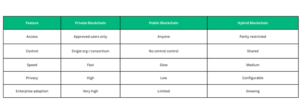
How is a private blockchain different from a public blockchain?
The main difference is control. Public blockchains are open to everyone. Private blockchains are restricted and business-focused.
For enterprises, this means faster performance, better privacy, and easier compliance without giving up transparency or trust.
Private vs Public vs Hybrid Blockchain
Who should hire a private blockchain development company?
A private blockchain development company is best for businesses where data trust directly impacts operations.
This includes:
- Financial institutions
- Healthcare organizations
- Supply chain and logistics companies
- Large B2B platforms
If your business depends on shared data accuracy, private blockchain is a strategic tool not a tech experiment.
Is a private blockchain secure?
Yes, private blockchains are built for enterprise-grade security.
They are secure because:
- Access is limited to verified users
- Data is encrypted and time-stamped
- Every action is traceable and auditable
Many companies adopt private blockchains specifically to reduce internal fraud and data manipulation.
Are private blockchains legal and compliant?
Yes, private blockchains are fully legal and widely used in regulated industries.
They support compliance because:
- Access control matches regulatory rules
- Audit logs are automatic and tamper-resistant
- Data visibility can be restricted by role
This is why regulators often trust private blockchains more than traditional systems.
Real business use cases of private blockchain
Finance and banking
Banks use private blockchains for inter-bank settlements.
Impact: Faster settlements and reduced counterparty risk.
Healthcare
Hospitals share patient data securely across departments.
Impact: Fewer data errors and improved patient safety.
Supply chain
Companies track goods end-to-end.
Impact: Up to 40% fewer disputes due to shared, trusted records.
Private blockchain vs traditional databases
A private blockchain is not just another database.
- Databases can be edited without trace
- Private blockchains create a shared, tamper-proof history
This matters when multiple organizations rely on the same data and trust is critical.
When does private blockchain development actually make sense?
Private blockchain development makes sense when:
- Multiple parties update shared records
- Manual reconciliation causes delays
- Compliance audits are frequent
- Data errors create financial risk
In these cases, blockchain reduces coordination costs and operational friction.
Why many blockchain projects fail without the right partner
Most failed blockchain projects fail because they:
- Choose public blockchains unnecessarily
- Ignore compliance needs
- Overbuild without business clarity
Working with a private blockchain development company helps align technology decisions with business reality from day one.
How to choose the right private blockchain development company
The right partner helps you:
- Decide whether blockchain is even needed
- Choose between private, public, or hybrid models
- Design for compliance and scalability
- Focus on outcomes, not hype
Blockchain success is more about decision-making than coding.
Frequently Asked Question
Do all businesses need a private blockchain development company?
No. If your system is internal and simple, a database may be enough.
A private blockchain development company is needed only when multiple trusted parties share data and trust or compliance is a concern.
Is private blockchain better than public blockchain for enterprises?
For most enterprises, yes.
Private blockchains offer better privacy, performance, and regulatory control, which are critical for real-world business operations.
Is private blockchain expensive to build?
Costs depend on scope and complexity.
However, businesses often save money long-term by reducing manual processes, disputes, and compliance overhead.
Can private blockchains integrate with existing systems?
Yes, Most enterprise blockchain solutions are designed to integrate with existing ERP, CRM, and internal systems.
Final thoughts: making the right decision
Hiring a private blockchain development company is a business decision, not a technology trend.
The real question is not “Should we use blockchain?”
It is “Where does blockchain remove friction, risk, or cost from our operations?”
At Velvosoft, we help businesses answer that question first, then design private, public, or hybrid blockchain systems that actually support long-term growth.