Table of Contents
Choosing the right blockchain for your DApp in 2026 is no longer just a technical choice—it is a long-term business strategy. The blockchain you deploy on affects your transaction costs, user experience, scalability, security, and even how investors perceive your product. With more than $250 billion in stablecoins, growing enterprise adoption, and millions of users entering Web3 through games, NFTs, and financial apps, the competition between Polygon vs Ethereum vs BSC has never been more relevant.
Each of these blockchains serves a different purpose. Ethereum prioritizes security and trust, BNB Chain focuses on speed and affordability, and Polygon aims to balance scalability with Ethereum-grade security. In 2026, founders are no longer asking “Which chain is best?” but rather “Which chain is best for my specific DApp?” This guide breaks it down clearly—using real stats, case studies, analogies, and practical recommendations—to help you make the right deployment decision with confidence.
Ethereum vs BSC vs Polygon: A High-Level Comparison
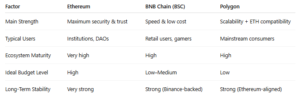
At a high level, this comparison shows why different blockchains attract different types of projects. There is no “one-size-fits-all” winner. Each chain is optimized for a specific business need.
Ethereum: Built for Maximum Trust
Ethereum’s biggest strength is security and decentralization. It is trusted by institutions, governments, and large DeFi protocols because it has the largest validator network and the most battle-tested smart contract infrastructure. This makes Ethereum ideal for applications that manage high-value assets, long-term financial contracts, or DAO treasuries. The trade-off is cost. Ethereum requires a higher budget due to gas fees, but in return, you get unmatched trust and long-term stability.
BNB Chain (BSC): Optimized for Speed and Growth
BNB Chain is designed for fast execution and low transaction costs. This is why it attracts retail users, gamers, and high-activity apps. If your goal is to launch quickly, test ideas, or serve users who make many small transactions, BSC offers a strong advantage. Its ecosystem is mature and backed by Binance, which gives it access to a massive global user base. However, this speed comes with lower decentralization, which may not suit high-value or institutional use cases.
Polygon: The Balanced Scaling Layer
Polygon is positioned as the middle ground between Ethereum and BSC. It delivers low fees and high throughput while staying closely aligned with Ethereum’s security model. This makes Polygon ideal for mainstream consumer applications, NFT platforms, loyalty programs, and Web3 apps that want a Web2-like experience. With Ethereum compatibility and long-term scalability through AggLayer, Polygon is often the best choice for founders who want to scale without locking themselves into a single chain.
Ethereum, BSC, and Polygon at a Glance
Why Speed, Cost, and Trust All Matter in 2026
In early Web3, developers chose chains based on ideology. In 2026, users choose based on experience.
- Slow confirmations = abandoned transactions
- High gas fees = fewer active users
- Poor security = zero institutional trust
That’s why modern DApps often combine chains, using Polygon or BSC for daily activity while relying on Ethereum for settlement and security. This approach reflects how real-world infrastructure works—local roads for daily travel and highways for long-distance value movement.
FAQs: Polygon vs Ethereum vs BSC
1. Which blockchain is best for deploying a DApp in 2026?
There is no single best blockchain. Ethereum suits high-value and institutional apps, BSC works best for fast and low-cost consumer apps, and Polygon is ideal for scalable, mass-market DApps.
2. Why is Polygon often preferred over Ethereum for NFT marketplaces?
Polygon offers much lower fees and faster confirmations than Ethereum, making NFT minting and trading affordable and user-friendly at scale.
3. Is BNB Chain less secure than Ethereum?
BNB Chain is secure for most consumer apps but is more centralized than Ethereum, which makes Ethereum better for high-value DeFi and institutional use cases.
4. Can I deploy the same DApp on Ethereum, Polygon, and BSC?
Yes, since all three are EVM-compatible, most DApps can be deployed across them with minimal changes, and multi-chain deployment is common in 2026.
5. What role does Polygon’s AggLayer play in the future?
Polygon’s AggLayer connects multiple chains into a single liquidity layer, making multi-chain apps feel seamless for users without compromising security.
Final Conclusion: Where Should You Deploy Your DApp in 2026?
The Polygon vs Ethereum vs BSC debate in 2026 is no longer about choosing a single “winner.” It’s about choosing the right tool for the right job.
Ethereum remains the backbone of Web3, offering unmatched security and trust for high-value applications, institutional DeFi, and long-term financial infrastructure. BNB Chain continues to win on speed and affordability, making it ideal for fast-growing consumer apps, games, and platforms that rely on frequent transactions. Polygon stands out as the most balanced option, combining low fees, high scalability, and Ethereum compatibility—making it the preferred choice for mass-market DApps and mainstream adoption.
The biggest shift in 2026 is that successful DApps are multi-chain by design. Founders who understand user behavior, cost sensitivity, and trust requirements can strategically use Ethereum for settlement, Polygon for scale, and BSC for performance.