Table of Contents
If you try to hire blockchain developers in the US, you’ll quickly see salaries touching $110,000 to $200,000+ especially for specialized roles like smart contract security, DeFi engineering, and Layer-2 development. These costs make it extremely hard for startups to scale.
But the good news is this:
You can dramatically reduce the hire blockchain developers cost by tapping into global talent pools in India, Eastern Europe, and Latin America. With the rise of remote work, blockchain development outsourcing and Employer of Record (EOR) hiring models make it possible to find world-class talent without paying Silicon Valley salaries. This becomes even easier when you partner with a team that already specializes in end-to-end Blockchain Development Services.
The Real Reason US Blockchain Expensive Salaries
Blockchain adoption is exploding across industries like DeFi, supply chain, gaming, tokenization, healthcare, identity systems, and more. Because the demand is skyrocketing faster than the supply, blockchain developer salary benchmarks in the US have become extremely high in 2025.
Companies no longer want generalists. They want deep specialists which pushes salaries even higher.
US Salary Benchmarks for Blockchain Roles in 2025
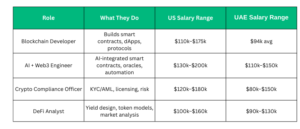
Senior protocol developers (Ethereum L2, Solana, Cosmos, Bitcoin L2) can easily cross $300,000+ per year, making them some of the highest-paid engineers in the industry. This is why so many startups shift toward offshore blockchain talent to build strong, scalable teams without burning through their runway. And if your product needs deep protocol-level engineering or custom architecture, partnering with a team experienced in Custom Blockchain Solutions can help you ship faster while keeping your development budget under control.
Global Hiring Strategy: How Startups Cut Costs by 70%–90%
Web3 is remote-first by design, meaning you can hire globally without losing skill quality. This allows startups to tap into offshore blockchain developers in regions like India, Eastern Europe, and Latin America at a fraction of U.S. salaries.
Cost to hire Web3 developers varies greatly by location: a senior engineer in Silicon Valley can earn $150K–$300K+, while an equally skilled developer in India or Poland may cost $12K–$54K annually. Remote teams also benefit from overlapping time zones, enabling nearly round-the-clock productivity without the huge overhead of local hires.
Global Blockchain Developer Salary Comparison
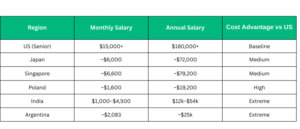
India has over 60,000 skilled blockchain engineers proficient in Solidity, Rust, Go, Substrate, and Move, making it one of the most cost-efficient destinations to hire senior Web3 developers. Startups can leverage blockchain development outsourcing models to tap into this talent pool, gaining high-quality expertise at a fraction of U.S. salaries.
This makes India ideal for projects that need rapid development, specialized protocol skills, and flexible remote teams without inflating costs.
What Actually Determines Blockchain Hiring Cost?
The hire blockchain developers cost depends mainly on two things:
Specialization (The Most Expensive Factor)
You pay more when you need rare, high-value skills, such as:
- Ethereum DeFi Developers – Experts who can design and deploy decentralized finance protocols, optimize yield strategies, and ensure secure tokenomics. These developers are crucial for projects looking to build robust DeFi platforms.
- Solana Rust Engineers – Developers specializing in Solana’s high-performance blockchain using Rust. They build fast, scalable smart contracts and on-chain programs critical for low-latency applications.
- Zero-Knowledge (ZK) Circuit Developers – Specialists who work on privacy-preserving cryptography and zk-SNARK/zk-STARK protocols. Their skills are rare and highly sought after for confidential transactions and layer 2 solutions.
- Smart Contract Auditors – Professionals who thoroughly review and secure smart contracts to prevent vulnerabilities and potential exploits that could lead to multimillion-dollar losses. For projects that need secure and optimized smart contracts, hiring experienced smart contract auditors is essential. Startups looking to manage costs can explore Smart Contract Development services to access vetted auditors and developers without paying top-of-market US salaries.
- AI + Blockchain Hybrid Engineers – Developers combining artificial intelligence with blockchain for predictive analytics, decentralized oracles, and innovative dApps.
These highly specialized roles often command hourly rates of $80–$200+ in the US, depending on seniority and complexity of the project.
For startups looking to hire blockchain developers cost-effectively, leveraging offshore talent or blockchain development outsourcing models can significantly reduce expenses without compromising quality. For example, similar roles in India, Eastern Europe, or Latin America may cost 40–70% less, making it possible to hire a full blockchain team with global expertise within budget.
Location (The Cost Arbitrage Opportunity)
Location changes everything when it comes to hire blockchain developers cost:
US: Commands the highest salaries globally, often $110k–$200k+ annually for senior developers. Ideal for founders who prioritize local talent integration and IP security, but it’s expensive.
UAE / Singapore: Competitive salaries slightly below US rates. Attractive for startups seeking a blockchain-friendly regulatory environment and strong tech infrastructure.
India / Eastern Europe: Offers the best cost-to-talent ratio, combining highly skilled developers with affordable rates. Ideal for startups leveraging blockchain development outsourcing.
LATAM (Latin America): Affordable talent with strong English proficiency and growing blockchain expertise. Emerging as a top choice for remote-first teams.
Because of these differences, many founders now prefer to hire offshore blockchain developers instead of relying solely on local hires. This allows them to scale their teams, access specialized skills, and optimize project budgets without compromising quality.
Best Balance: EOR + Offshore Developers
Combining Employer of Record (EOR) with offshore blockchain developers is a cost-effective, compliant way to hire skilled talent without paying US-level salaries.
1. Cost Efficiency
Offshore developers from India, Eastern Europe, and LATAM cost much less than US salaries.
EOR removes the need for local entities and legal overhead.
Access full-time, committed blockchain developers.
2. Compliance
EOR handles payroll, taxes, and local regulations.
Protects from misclassification penalties.
3. Specialized Skills
Hire developers skilled in Solidity, Rust, Substrate, Move.
Roles include smart contract auditors and AI + blockchain engineers.
4. Productivity
Remote teams allow round-the-clock development.
Structured overlaps ensure smooth communication and faster delivery.
Vetting: How to Avoid Fake or Unskilled Developers
Remote hiring can bring fake profiles, copied portfolios, and low-skill applicants. Protect your project by verifying skills through real GitHub contributions and technical tests, checking backgrounds with video interviews and identity confirmation and using trusted hiring models like EOR or verified agencies like Velvosoft to ensure compliance and quality.
Focus on Core Skills
Red Flags & Verification: Check for fake profiles, copied resumes, weak skills, or poor communication. Verify with portfolio, GitHub, and interviews. Use EOR hiring for full-time remote roles.
Specialized Roles & Costs: High-demand roles like Ethereum DeFi, Solana Rust, ZK developers, smart contract auditors, AI+Web3 engineers cost $80–$200+/hr US. Offshore teams reduce cost without losing quality.
Best Cost Strategy: Combine EOR + offshore developers for full-time teams at a fraction of US salaries.
Remember: If an interviewer seems uninterested or distracted, it’s usually a red flag. The same applies to candidates.
Final Thoughts
Relying solely on high-cost US hiring can quickly drain your budget before your product even launches. The smart approach is to adopt a global hiring strategy, combining offshore blockchain developers, blockchain development outsourcing, and compliant models like Employer of Record (EOR).
With careful vetting of skills, focusing on specialized expertise (Solidity, Rust, smart contract security, dApp development), and leveraging cost-effective regions like India, Eastern Europe, and LATAM, you can hire elite talent without paying $200K+ salaries.
Hiring blockchain developers is like fishing. If you fish only in the most expensive waters (US), your catch is small and costly. But casting a global net brings a bigger, higher-quality catch at a fraction of the cost, enabling faster product development and long-term scalability.