Table of Contents
- When You Should Launch a Token ▶
- When to Avoid or Delay Token Launch ▶
- Successful Crypto Platforms Without Tokens
If you’re building a crypto or Web3 product, one of the biggest strategic questions you’ll face is:
Do I need a token for my crypto platform or can I operate without one?
This decision affects your revenue model, user growth, regulatory risk, fundraising options, and even the long-term survival of your project. While adding a native token can unlock liquidity, decentralization, and community incentives, launching too early or without clear utility introduces serious regulatory, financial, and technical risks.
This guide breaks down when to launch a crypto token, when not to, token vs no-token business model comparisons, and successful crypto platforms without tokens, so you can make the right decision.
When You Should Launch a Token
A native token becomes useful when your ecosystem needs:
- A medium of exchange
- Governance participation
- Incentive alignment
- Liquidity
- Programmatic access control
In these situations, tokenizing your platform gives you advantages equity or fiat cannot match.
A. Economic & Liquidity Advantages
Tokens allow you to raise capital faster, create early liquidity, and reduce friction between users and contributors.

Story Example
If you build a decentralized marketplace, a token lets buyers and sellers govern fees. They trust you more because you can’t change rules centrally. This lowers your CAC and increases platform stickiness.
B. Organizational & Governance Strength
If your long-term plan involves community ownership, a token is often necessary.
- Utility Tokens enable payments, staking, access
- Governance Tokens enable voting, proposals, decentralization
These are crucial for:
- DAOs
- DeFi protocols
- Gaming economies
- Decentralized social networks
- Infrastructure platforms
If decentralization is part of your business strategy, tokenization becomes essential.
When to Avoid or Delay Token Launch
A token isn’t always necessary. In many early-stage platforms, a token increases cost, legal complexity, and project risk without adding business value.
Follow the KISS rule:
Keep It Simple Until Token Utility Is Obvious
A. Regulatory Risk: The #1 Reason Founders Delay
The biggest mistake founders make is launching a token before understanding securities law.
U.S. SEC
Most tokens fail the Howey Test if:
- Buyers expect profit
- Value depends on founder effort
To avoid being classified as a security, your token must be immediately usable, utility-first, and not marketed as an investment.
EU MiCAR
Utility tokens are only allowed if the token:
- Gives access to your product
- Doesn’t grant profit claims
- Doesn’t allow corporate governance voting
If not, it’s treated as a financial instrument → heavy compliance.
Case Study: The True Cost
A Security Token Offering (STO) under Reg A+:
- Takes 6–12 months to approve
- Caps raises at $50M/year
- Requires extensive disclosures
- Adds ongoing auditing and reporting
For many startups, this complexity is not worth it.
B. Technical & Financial Risks
Launching a token adds serious engineering and financial overhead.
1. Volatility & Whales
If whales accumulate your tokens early, they can dump later → price crashes → ecosystem dies.
This is why “token crash = bankruptcy.”
2. Smart Contract Bugs
Famous failures:
- DAO Hack: $60 million stolen
- Parity Wallet Bug: $150 million frozen
3. Audit Costs
You cannot skip audits.
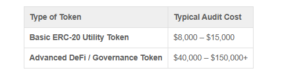
These costs are necessary not optional.
Token vs No-Token Business Model

Successful Crypto Platforms Without Tokens
Many profitable and high-usage platforms operate without a native token:
- Base (Coinbase L2) — uses ETH for fees
- MetaMask — no token
- Ledger / Trezor — no token
- Etherscan — no token
- OpenAI’s Sora & ChatGPT models (crypto-related integrations) — no tokens
These companies prove you can build billion-dollar businesses without launching a token.
Should You Launch a Token or Focus on Fees?
Launch a Token If:
- Your users need governance
- You need decentralized incentives
- Your revenue depends on network activity
- Token utility is clear and unavoidable
Focus on Fees If:
- Your platform is SaaS-like
- Centralization improves UX
- You want minimal legal friction
- You want predictable revenue
Think Stripe vs Uniswap:
- Stripe wins by focusing on fees.
- Uniswap wins because decentralization matters.
FAQs
1. Can a DeFi platform work without a token?
Yes. Many DeFi tools, aggregators, analytics platforms, security dashboards, and infra products don’t need tokens. Tokens add value only if your users need governance, staking, or incentives.
2. When should I issue a native token?
Only when the token’s utility is critical to your ecosystem — governance, access, staking, liquidity, or rewards.
3. Is creating a token worth the regulatory risk?
Only if your token’s value outweighs compliance cost. For many early-stage founders, it does not.
4. Can I build a crypto platform without a native token?
Absolutely. Plenty of successful platforms operate purely on fees, subscriptions, or API revenue.
Final Conclusion: So… Do You Actually Need a Token?
Launching a token is like building a rocket—fast, powerful, global, and capable of massive scale. But rockets also come with higher risk, higher cost, and more complexity. Building a platform without a token is like building a ship like steady, predictable, safe, and designed for long-term sustainability.
The rule is simple:
Choose a token only when your project truly needs speed, liquidity, decentralization, or incentive mechanisms that traditional business models cannot deliver.
For everything else, focus on the fundamentals:
- Product
- User adoption
- Revenue
- Fees
- Compliance
- A sustainable business model
Your business strategy, not hype, should decide whether you need a token.